 PRODRAFTSTATS™PRODRAFTSTATS™
We score every pick against his season average and leave the misses where you can see them.
We score every fantasy pick against the player's season average. More than 1.5 points above is a win, more than 1.5 below is a loss, anything within 1.5 a push. We timestamp picks before kickoff and keep misses on the card. Week 1 2026 is blank because it was never written down before kickoff.
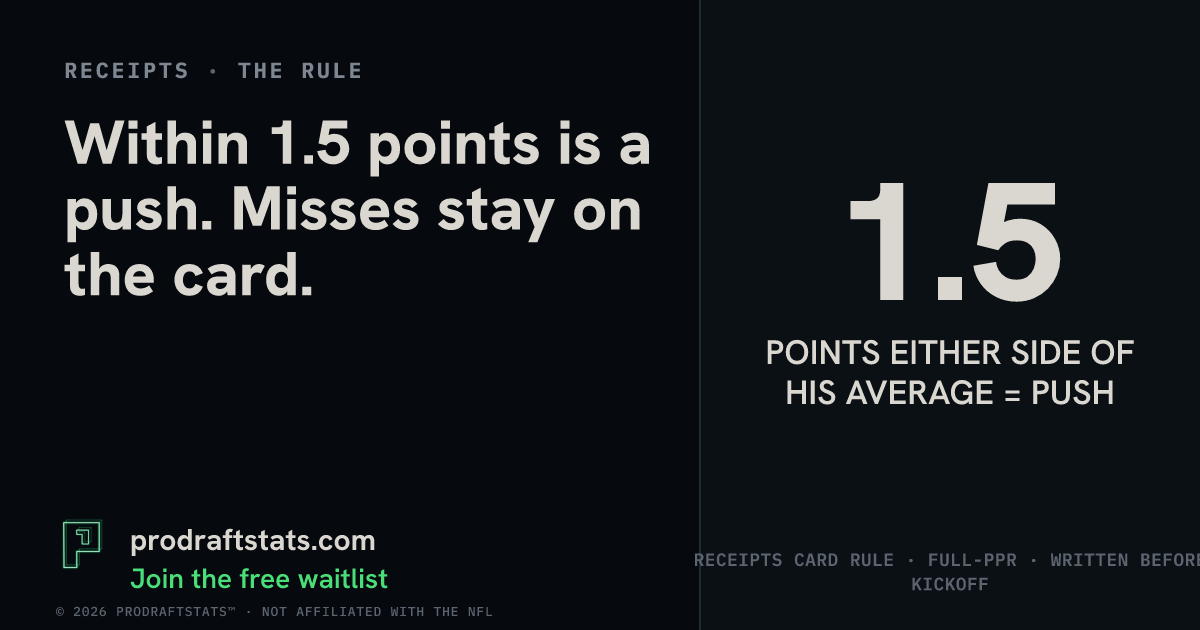
If someone in your league chat keeps telling you he called it, notice which calls never come up again. Fantasy content can work the same way: replay the hits, let the misses disappear, and you end up grading a highlight reel. Our Receipts card does the opposite. Every pick is written down before kickoff, scored against his season average, and left on the card whether it worked or not. You can grade each one yourself with one subtraction. The rule is short, and one week of our own record is blank because of it. Read on for the three-bucket rule, and for why we left Week 1 blank instead of filling it in after the fact.
Each pick is scored against the season average printed on the card, and that single comparison decides everything. The push check comes first. If his actual points land within 1.5 of his average in either direction, it is a push (P). If he finishes more than 1.5 above it, that is a win (W). If he finishes more than 1.5 below it, that is a loss (L).
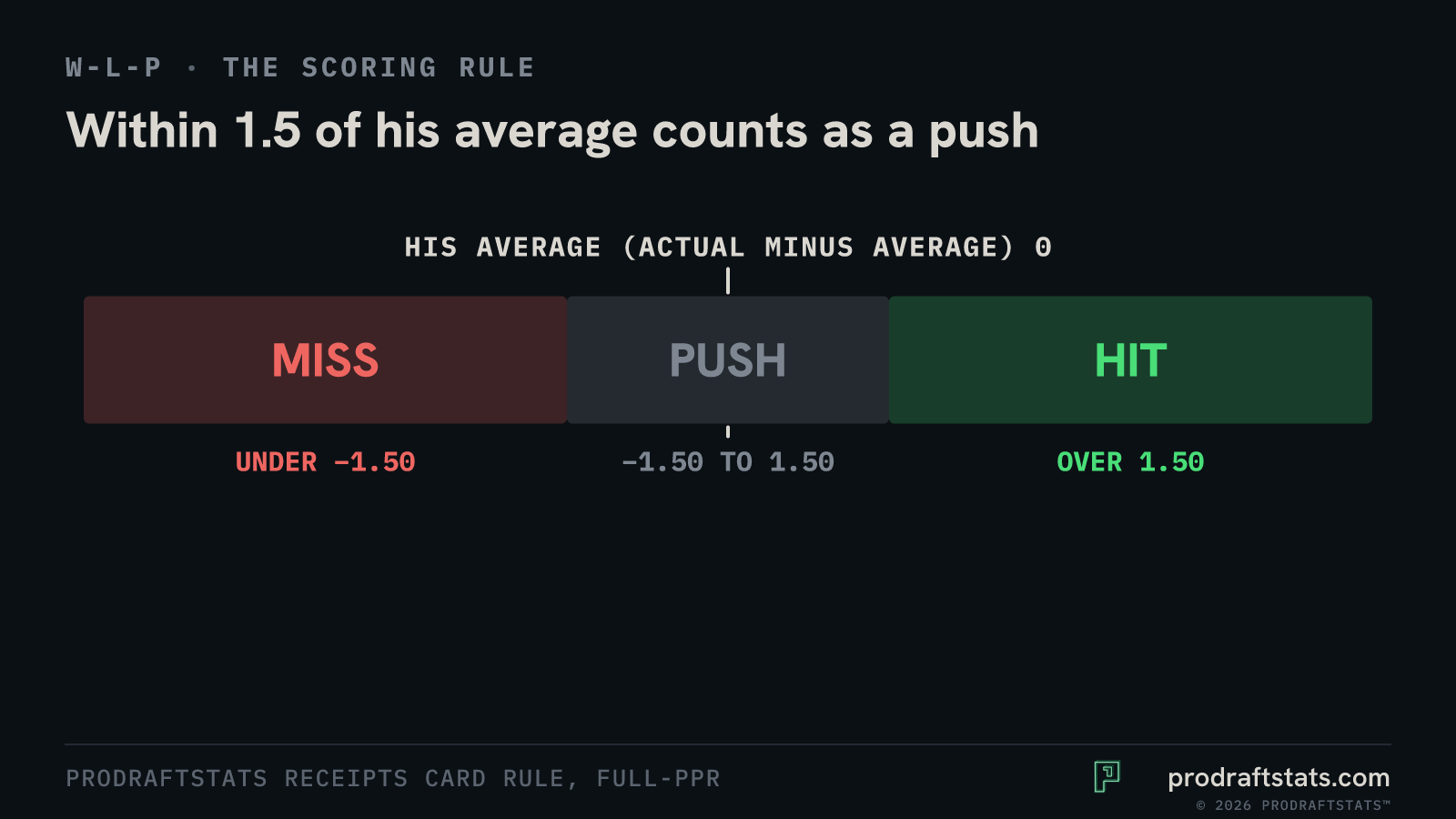
Do the arithmetic once: 1.5 above plus 1.5 below makes a push zone 3.0 points wide. A finish inside that zone counts as neither a win nor a loss, by rule. The 1.5 margin is a rule we set, not a measured noise level. One game is noisy anyway. A win or loss only says he finished above or below his own average by more than 1.5. It does not tell you whether the projection was right, because the rule never compares the actual score to the projection. A projection is a central estimate for one week, and a real score can land well above or below it.
Here is the catch about the labels: a win or loss here says nothing about whether you should have started him. A pick that projects below his average is a claim about his points, not a sit call, and the lineup choice stays yours.
But a scoring rule is easy to bend after the fact if the picks themselves can be changed. That is why the way a pick is stored matters as much as the way it is scored.
Survivorship bias is a common trap: when only the hits get replayed, trust can build on a partial record. The cure is a record where the misses cannot drop out.
That’s why the card is built the way it is. Each pick is committed with a timestamp before kickoff, so the claim exists before the result does, and it is scored against that copy, never a number redone after the games start. If the copy for a week is missing, the card says so by name instead of quietly rebuilding it.
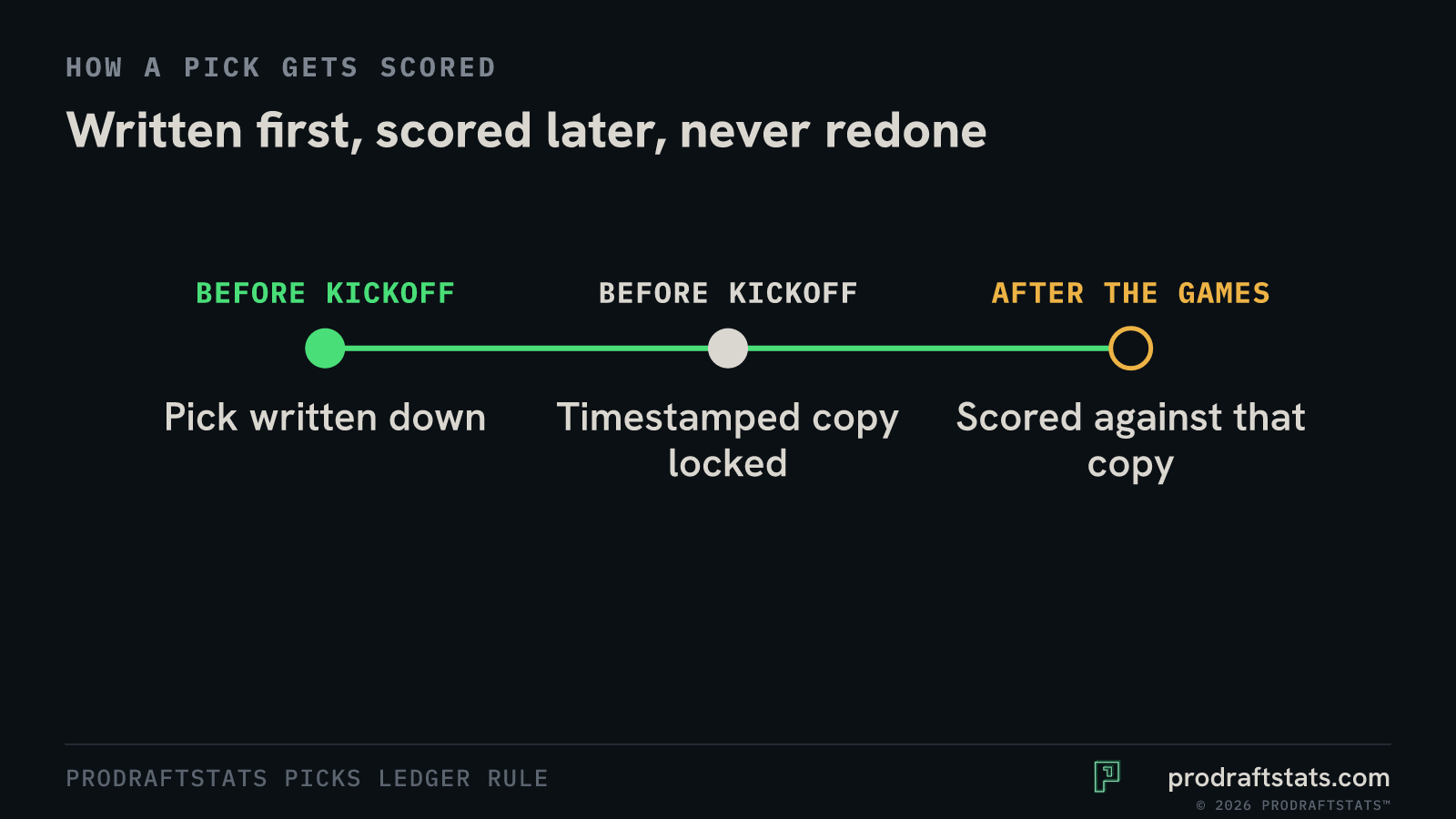
Because every pick is scored against the copy written before kickoff, a loss is scored by the same rule as a win, and a week can’t be rewritten after kickoff.
So the question is whether the rule has ever actually stopped us from doing something.
Week 1 2026 was never written down before kickoff, so no pre-kickoff copy exists, and we don’t lock a week after kickoff. That’s why the 2026 record starts at Week 2, and why we did not backfill Week 1 with numbers that could have been produced once the results were known. It is the one place this rule has already applied, which is a sign it binds us. It is not a guarantee about every case.
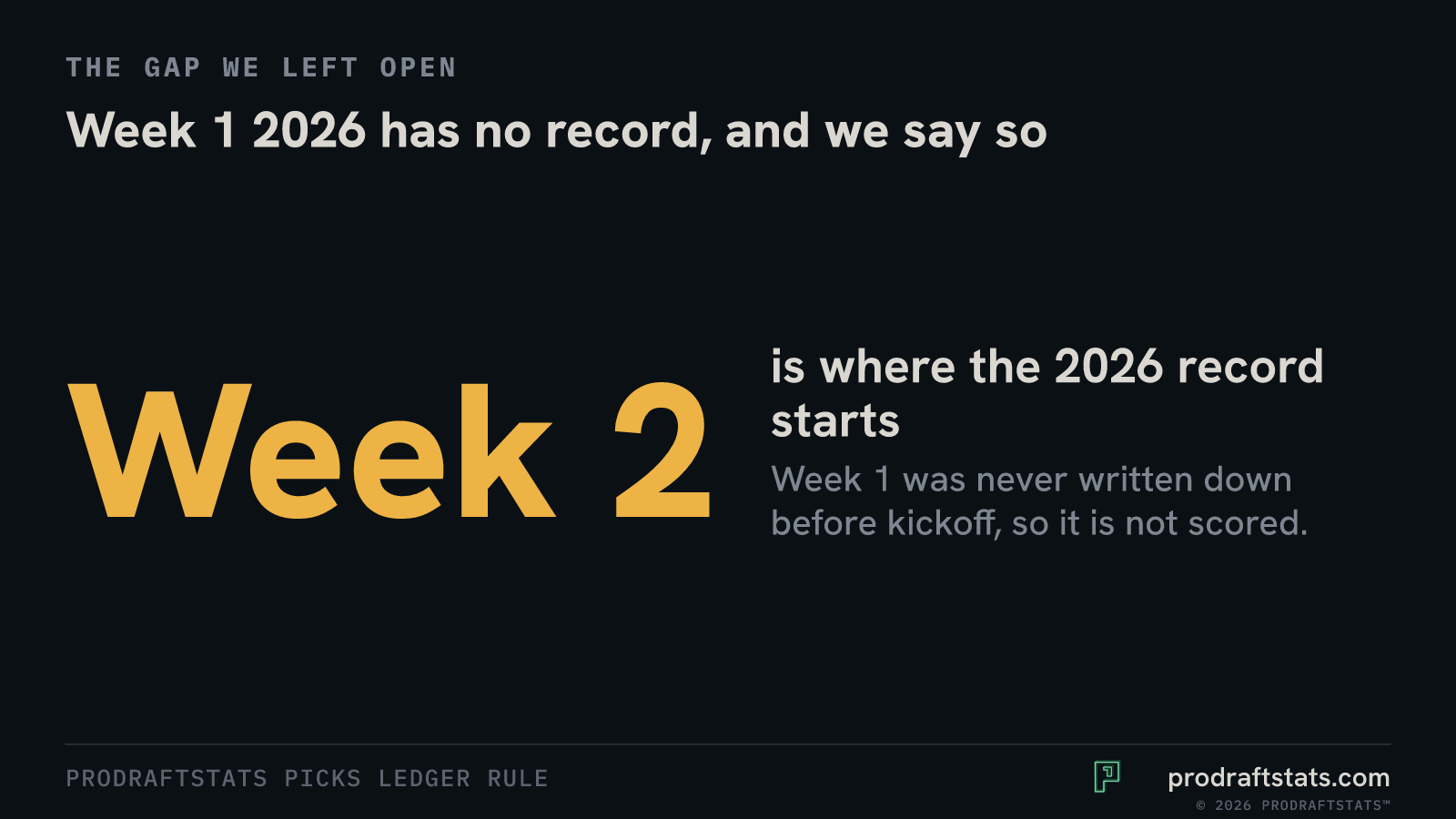
This post shows no W-L-P record and no Week 7 or Week 8 results. Week 1 2026 is absent because it was never written down before kickoff.
Send this to the one person in your league chat who keeps quoting last year’s hot take.
Source: ProDraftStats desk.
A push is when his actual points land within 1.5 of his printed season average, in either direction. That makes the push zone 3.0 points wide. A finish inside it counts as neither a win nor a loss.
No. A win or loss only says he finished more than 1.5 above or below his own average. A pick that projects below his average is a claim about his points, not a sit call. The lineup choice stays yours.
No. The 1.5 margin is a rule ProDraftStats set, not a measured noise level. The rule compares the actual score to his printed season average, never to the projection.
Week 1 2026 was never written down before kickoff, and we don't lock a week after kickoff, so the 2026 record starts at Week 2 instead of being backfilled.
ProDraftStats launches in 2027. Join the free waitlist.