 PRODRAFTSTATS™PRODRAFTSTATS™
Our projection sits next to ESPN’s on one screen, so the argument finally has two sides.
ESPN's projection sits beside ours, never blended in, so anyone can check the gap. Our number is timestamped before kickoff. The gap between the two stays grey until it has been earned on the scored record.
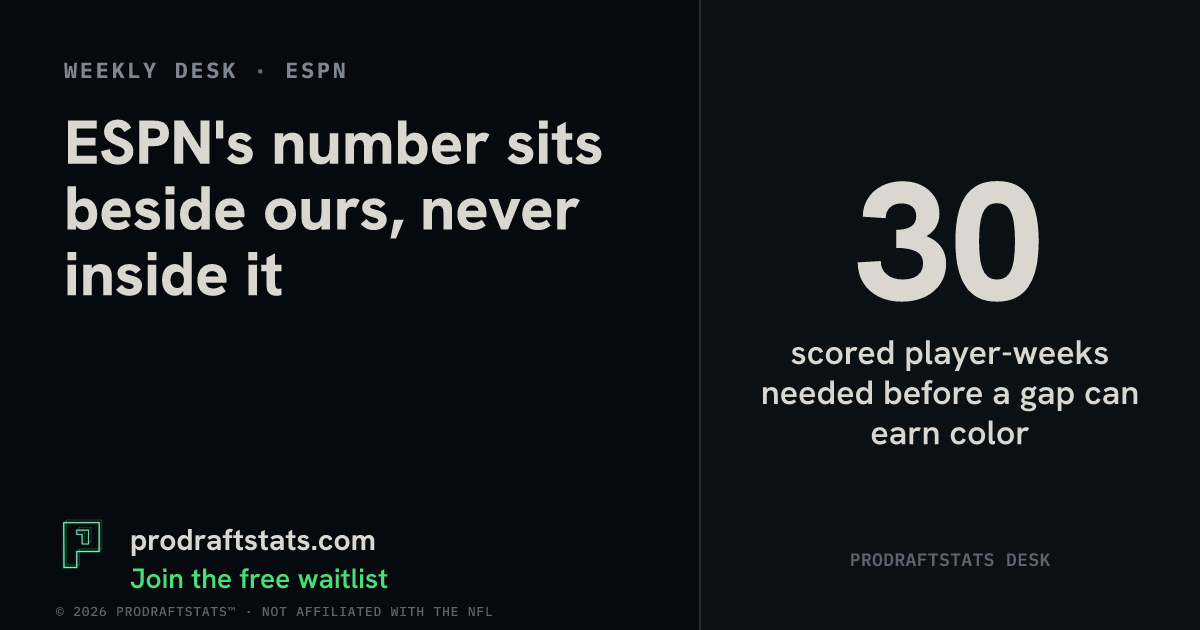
Send this to the person in your league chat who quotes ESPN’s projection like scripture. We’re not saying the number is bad. It’s just hard to judge when it’s the only one in the room. The weekly desk fixes that by putting ours right beside it, never mixed in, so when the two disagree on your guy you can see exactly where. Ours is written down before kickoff with a timestamp, which means we can’t quietly change our story after the games. Hindsight flatters every take, so the receipt matters. Winning the argument is up to you. What we do with the gap between the two numbers is stranger than you’d expect, and it starts below.
The weekly desk lines up four things. ESPN’s columns come first. Our own projection sits next to them. After that come the moves our numbers suggest, such as start/sit and pickups. Last is a record that writes every claim down before kickoff and scores it afterward.
A bench notice flags a starter on your ESPN lineup whom the desk’s numbers suggest sitting. It is information for your decision, not an instruction. Start/sit on the desk is built around the chance of winning the matchup, not a projection below a season average. If you opt in, AUTOPILOT can make the swap.
Our number is our own read of the player for the week, scored in full-PPR. It is finished before ESPN’s number is set beside it.
That raises the obvious question: if two numbers sit side by side, why not average them? ESPN has a staff, we have a model, and a mix of both sounds like it should beat either one.
Here’s the catch: a projection that has already read ESPN can’t be judged against ESPN. Agreement becomes automatic, and any test of it just measures an echo. A disagreement between two independent numbers can be checked; a blend is a single number nobody can check.
Agreement with the crowd feels like evidence. If our model had already peeked at the crowd, agreement would only be the crowd repeated back to us.
That’s why the gap wears no colour on day one. It can turn coloured only once it is bigger than ESPN’s own measured weekly error at that position, and that takes scored weeks. A colour on this screen has to be earned on the record.
Start/sit on the desk aims to maximise your chance of winning the matchup, not raw points. An underdog may sensibly give up some expected points for a wider range of outcomes, and a favourite the reverse.
So the desk may show a projection below a player’s season average. A projection below the season average is not a sit call. A projection is one central estimate for one week; the real score can land well above or below it, and we have no scored results yet to say how often it lands close.
That brings up a second habit: hindsight bias. Once the games are played, every half-made take feels like a call you got right. The record is built to take that option away.
Send this to whoever in your league chat treats ESPN’s projection as gospel.
Source: ProDraftStats desk.
A projection that has already read ESPN can't be judged against ESPN, because agreement becomes automatic. Keeping the two numbers separate means a disagreement on a player can actually be checked.
Only once the gap is bigger than ESPN's own measured weekly error at that position, which takes scored weeks. There are no 2026 results yet, so it stays grey.
A projection below the season average isn't a sit call. It's one central estimate for one week, and start/sit is built on your chance of winning the matchup, not raw points.
ProDraftStats launches in 2027. Join the free waitlist.